Enemies are loud; allies are quieter, and easy to forget. Yet the truth of Israel's standing is the opposite of isolation. It has a deep, decades-old bond with the United States, a wave of Arab states making peace, durable treaties on two borders, partners across Europe and Asia, and the support of tens of millions of ordinary people who will never appear on a map.
The United States
The cornerstone. The closest alliance Israel has, and one of the closest in the world.
Since 1948, Washington has been Israel's indispensable partner: in arms, in money, in diplomacy and in the shared conviction of two democracies. A standing agreement commits the US to roughly $3.8 billion a year in military aid ($38 billion over a decade). That money helps fund the Iron Dome that intercepts the rockets, and it guarantees Israel's qualitative military edge, the legal commitment that Israel's weapons stay a generation ahead of any combination of regional threats. The US also shields Israel at the UN Security Council, the UN body that can authorize sanctions or force, using its veto dozens of times. In 2026, US and Israeli forces struck Iran's nuclear and military program together, the alliance at its sharpest.
It runs both ways. The aid is not a blank cheque: under the agreement nearly all of it must be spent on American weapons, so the money flows back to US factories and defense jobs, in effect a subsidy for both sides. In return the United States gets one of its most valuable partners. The two countries jointly built the missile shields that guard Israel, Iron Dome, David's Sling and Arrow, and the US Army has since bought Iron Dome for its own forces. Israel feeds combat-tested upgrades back into American jets and weapons, shares intelligence that has foiled attacks far beyond the Middle East, and serves as a forward base for US technology and research. Washington designates Israel a major strategic partner for a reason: this is an alliance of mutual benefit, not charity.
And that is only the defense side. The civilian bond runs just as deep. Two-way trade reached about $55 billion in 2024, up 9 percent in a single year, and Israel, a country of barely ten million, sells America more than it buys. Three government-backed binational foundations, BIRD for industry, BSF for science and BARD for agriculture, have together put well over $1.4 billion into joint US-Israel research since the 1970s, seeding everything from medical devices to clean energy. And in the pharmacy Israel is quietly everywhere: about one in six generic prescriptions filled in the United States is made by Israel's Teva, the world's largest generic drugmaker, helping keep American medicine affordable.
The Abraham Accords
2020: the wall of Arab rejection began to fall.
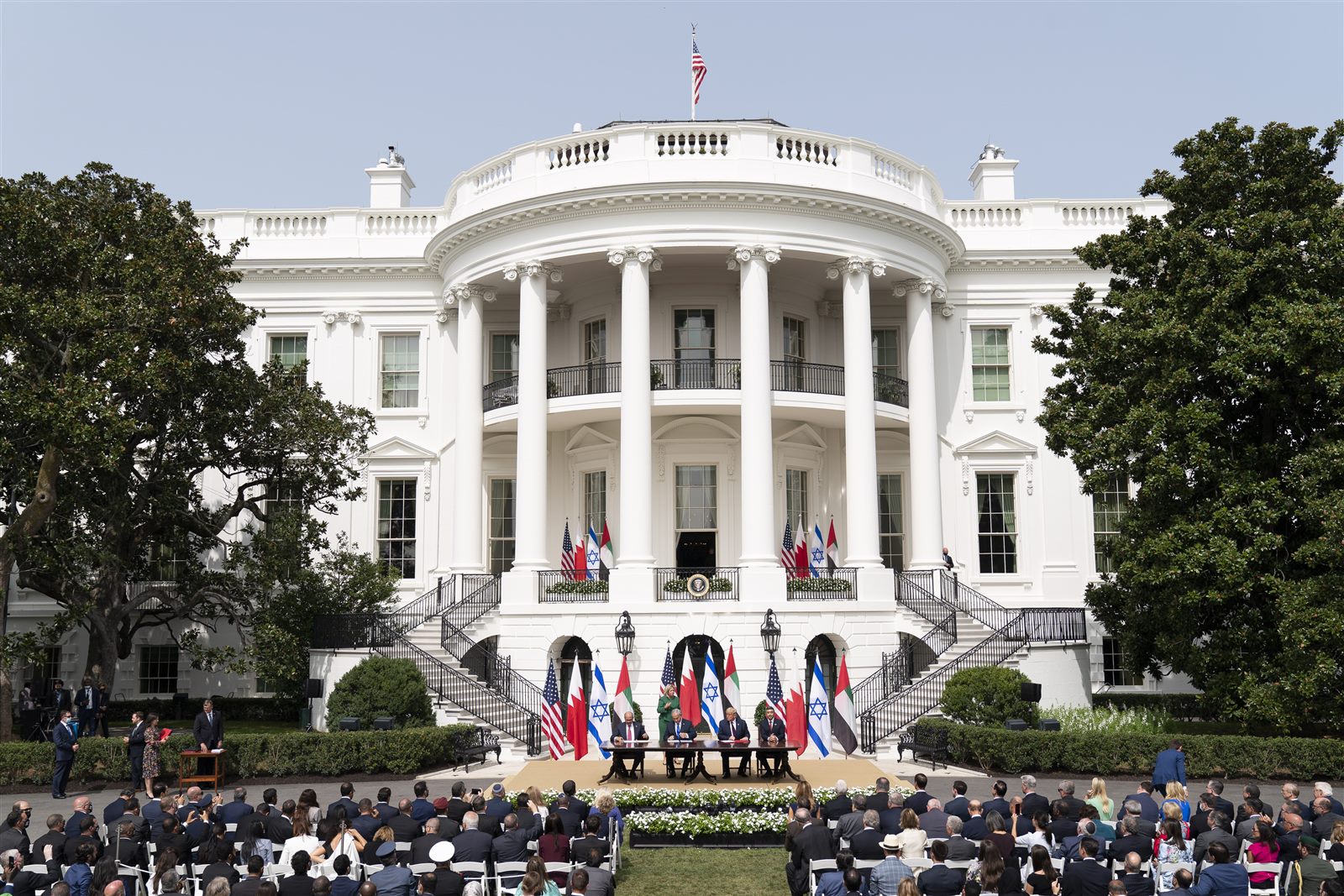
For seventy years the Arab world's official line was no recognition, no peace. Then in 2020 the United Arab Emirates and Bahrain normalized relations with Israel, followed by Morocco and Sudan. No Palestinian state was created first. The precondition that had frozen Arab-Israeli peace for seventy years, that recognition must wait on a Palestinian settlement, simply stopped being true. Embassies opened, flights began, billions in trade followed. It was a quiet revolution: Israel and much of the Gulf realigning together, largely against the shared threat of Iran.
The peace treaties
Two borders made quiet, and kept that way for decades.
Egypt (1979, after the US-brokered Camp David summit) and Jordan (1994) signed full peace treaties with Israel, ending generations of war on its longest frontiers. Egypt and Jordan have kept their embassies open and their treaties intact through the Gaza war itself, forty-seven and thirty-two years respectively without a single reversal. Call that cold if you want. No other peace in the region has lasted half as long.
Friends across the world
Beyond the headlines, a web of partners.
Germany
Bound by the weight of history, a steadfast supporter and supplier of the submarines that anchor Israel's deterrent.
India
A booming strategic partnership: one of Israel's largest arms customers and a fellow democracy facing jihadist terror.
Greece & Cyprus
Eastern Mediterranean partners in energy and defense, drawn close as Turkey drifted.
Azerbaijan
A Muslim-majority neighbor of Iran and a major energy supplier to Israel. Israeli-made Harop loitering munitions, drones that circle overhead until they find a target, were decisive in Azerbaijan's 2020 war against Armenia, the clearest combat proof anywhere of Israeli defense technology.
The UK & Canada
Long-standing Western allies and intelligence partners on operations that never make the news. Public criticism has never once stopped the votes, the trade or the shared intelligence.
Central Europe
The Czech Republic, Hungary and others are among Israel's most reliable voices inside the EU.
The people, not just the states
The support that never shows up in a treaty.
Israel's deepest reservoir of friendship is not governmental at all. Tens of millions of Christians, evangelicals above all, support Israel out of faith and conviction, a force in American politics larger than the Jewish community itself. And the Jewish diaspora, scattered by the very exiles this site traces, remains tied to the homeland by an unbroken thread. States calculate; these millions simply stand.