The land bridge, and the conductor
For years the spine of the network ran through Syria. Under Bashar al-Assad, propped up by Iranian money and Hezbollah fighters, Syria was the corridor that smuggled Iranian weapons overland to Lebanon. Assad's fall in late 2024 severed that artery, a rare and serious blow to the project. Coordinating it all is the Quds Force, the IRGC's external arm, whose late commander Qassem Soleimani spent two decades stitching these fronts into one. The point of this setup is that Tehran can wage war on Israel on every border at once while keeping its own hands at a distance.
Iraq: the same front, two masters
The militias on Israel's eastern flank are new; the threat from Iraqi soil is not. For seventy years Iraq has menaced Israel under whoever ruled in Baghdad. In 1948 an Iraqi expeditionary force joined the invasion of the new state, and Iraq alone among the attackers never signed an armistice, the ceasefire agreement that formally ends a war, so on paper Iraq has stayed at war with Israel for seventy years. It sent troops again in 1967, and in 1973 rushed some 18,000 soldiers and an armoured division to the Golan front against Israel.
Then came the nuclear gambit. By 1981 Saddam Hussein was building a reactor at Osirak, near Baghdad, that Israel judged a bomb programme in waiting. On 7 June 1981, in Operation Opera, Israeli jets destroyed it before it could be fuelled, a strike the world condemned at the time and quietly thanked a decade later. In the 1991 Gulf War, Saddam fired around 39 Scud missiles at Tel Aviv and Haifa, hoping to drag Israel into the war and split the Arab coalition against him. Israel, at Washington's urging, absorbed the blows and did not retaliate.
Struck first with 39 Scuds. Answered with zero.
Saddam's Iraq was Iran's bitter enemy; the two fought an eight-year war that killed a million people. Yet from opposite sides of that divide, both turned the same ground toward the same target. Today it is Tehran's militias who fire from Iraq. The master changes. The front does not.
The regime's first victims
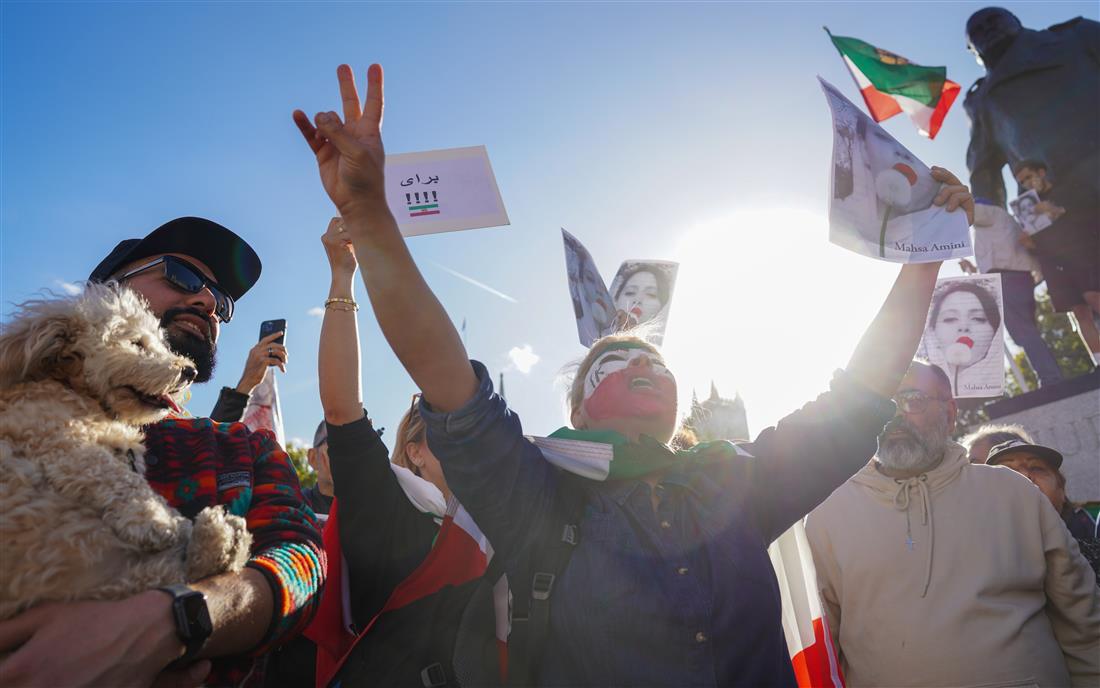
The IRGC's deadliest war is the one it wages at home. In 1979, Islamists seized one of the world's oldest civilizations, and Iranians have been trying to take it back ever since. In January 2026, the largest uprising since the revolution swept more than 200 cities. The regime answered, on Khamenei's orders, with live fire and a nationwide internet blackout built to hide the killing.
The true toll is unknowable, and that is by design. Tehran admits barely 3,000, but the regime cut the internet to hide the count, burned bodies to keep them off the ledger, and threatens the families who dare to mourn aloud. Independent monitors put the figure far higher: the diaspora agency HRANA has named over 7,000 of the dead, ages and hometowns published, a list Tehran has never disputed by name, with more than 11,000 further cases still being verified. Iran International reported at least 12,000. In Rasht, the Guards trapped protesters inside the bazaar and set it ablaze, finishing off the wounded in the hospitals. Near Tehran, Amnesty verified footage of an overflow morgue holding the bodies the official one could no longer fit, as morgues and hospitals filled past capacity. Believe none of the regime's numbers: the published numbers are a floor, not a ceiling, and this is already the deadliest crackdown in modern Iranian history.
And the record is still being buried. Iran's blackout became the longest nationwide internet shutdown ever recorded. Even now, after a partial return of connectivity, the regime keeps social media blocked and access curated for favored groups, so the civilian footage and the full toll have still not surfaced. The worst of what was done may only be seen when the lights finally come back on.
And here is the point too often missed: the Iranian people are not Israel's enemy. The same Guard Corps that arms Hamas and Hezbollah turns its rifles on Iranian teenagers chanting for freedom. Many Iranians are the regime's bravest opponents, and quiet friends of Israel. زن، زندگی، آزادی: Woman, Life, Freedom.
Scrolly images, via Wikimedia Commons: Hezbollah parade (Voice of America, public domain); Qassam Brigades exercise (Hadi Mohammad, CC BY 4.0); Houthi protest (Henry Ridgwell / VOA, public domain); Popular Mobilization Forces (Mohammad Mehdi Dara, CC BY 4.0); Khamenei and Soleimani (khamenei.ir, CC BY 4.0).