You have heard BDS call itself a peaceful movement for rights. Read its three demands closely, and the third one says the quiet part out loud: the end of the Jewish state.
The Boycott, Divestment and Sanctions movement asks for three things, and the first two sound unanswerable: end the occupation, treat Arab citizens equally. Its third demand is the one it doesn't want you reading closely.
But BDS takes no public position on whether Israel should exist at all, by design, so it can hold people who just want policy changes, and people who want Israel gone, under one banner. And its third demand quietly says what the other two are built to avoid saying. Here is each demand: what it says, and what it means.
They Say the Quiet Part
You do not have to infer the goal. The movement states it. Defending the “right of return,” BDS's own material admits it would “effectively end the Israeli regime” and its Jewish majority, then insists this is somehow not the elimination of Israel.
Its co-founder, Omar Barghouti, has been plainer still. He said:
“No Palestinian, rational Palestinian, not a sell-out Palestinian, will ever accept a Jewish state in Palestine.”
He opposes not just the settlements, not just the occupation, but a Jewish state in any borders. The first two demands are the friendly face of that project. Barghouti's own life gives away the game: while demanding the world boycott Israeli universities, he completed his own graduate degree at Tel Aviv University.
GuessBDS co-founder Omar Barghouti wants the world to boycott Israeli universities. Where did he do his own graduate degree?
Tel Aviv University. A second master's degree there in 2009, then doctoral studies, while calling on everyone else to boycott it.
Guess2015: SodaStream closed its West Bank factory, a move BDS claimed as a win. Who lost their jobs?
About 500 Palestinian workers, earning Israeli minimum wage, better pay than most West Bank employers offered. The boycott lands on Palestinians first.
An Old Boycott
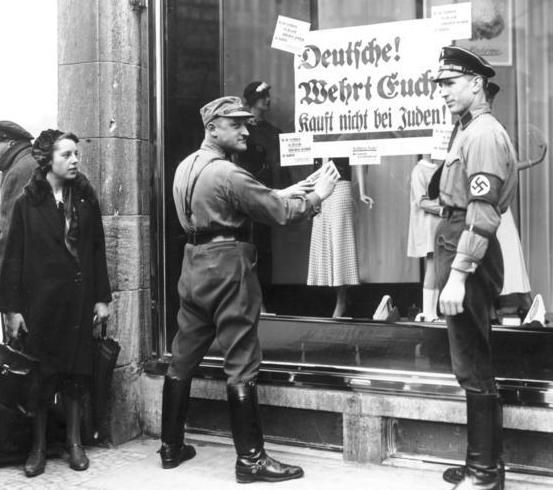
Boycotting Jews is not a new idea. In April 1933 the Nazi state launched “Kauft nicht bei Juden”, do not buy from Jews, stationing brownshirts (Nazi stormtroopers, the SA) outside Jewish shops. The medieval world had its versions too. A campaign to make the world refuse Jewish goods carries that history whether it means to or not.
Berlin, 1 April 1933: SA men post signs reading “Germans, defend yourselves, do not buy from Jews” on a Jewish shop.Bundesarchiv, Bild 102-14468 / Georg Pahl / CC-BY-SA 3.0
And it is, as ever, a double standard. There is no comparable global movement to boycott China over its Uyghur Muslims, Iran over its hangings, Syria over its barrel bombs, or any of the world's actual tyrannies. Only the one Jewish state draws the campaign. See the double standard →
And it hurts the people it claims to help. When SodaStream closed its West Bank plant in 2015, a move BDS claimed as its win, the people who lost their jobs were the roughly 500 Palestinian workers who had been earning Israeli minimum wage, better pay than most West Bank employers offered. The boycott is felt first by Palestinian workers, last by the state it is aimed at.
What it adds up to. Criticizing Israeli policy, even harshly, is legitimate. But BDS is not a critique of a policy. By its third demand and its founders' own words, it is a programme to dissolve the one Jewish state through the “return” of millions, while denying that this is what it is. A movement that has to hide its goal has already told you what it is. On the inherited-forever refugee category it leans on, see the forgotten refugees; on the hatred it echoes, the oldest hatred.
End Israel's occupation of “all Arab lands” and dismantle the separation barrier.
Reasonable on its face. But the phrase “all Arab lands” is left undefined on purpose. To the movement's founders it does not mean the West Bank captured in 1967; it means all of Israel, the 1948 lines included. The barrier, built during the suicide-bombing campaign of the Second Intifada (2000 to 2005, a Palestinian uprising that included a wave of suicide bombings), cut successful attacks from the northern West Bank, where it went up first, by more than 90%.
“Equality for Arab citizens”
Full equality for the Arab-Palestinian citizens of Israel.
Also unanswerable as worded, and also a sleight of hand. Israel's roughly two million Arab citizens already vote, sit in the Knesset (Israel's parliament) and on the Supreme Court, and serve as doctors, lawyers and diplomats. Real inequalities exist and deserve fixing, as in any democracy. The demand is framed to imply a denial of rights that the facts do not support.
“The right of return”
The “right of return” of Palestinian refugees, per UN Resolution 194.
true
This is the demand that ends Israel, and the movement knows it. UN General Assembly Resolution 194 (1948) was a non-binding recommendation that spoke of refugees “wishing to live at peace with their neighbours,” and of compensation as an alternative, nothing like the demand built on top of it. It calls for the “return” not of the few surviving 1948 refugees but of some 5.9 million descendants, counted as refugees forever, and not into a future Palestinian state but into Israel itself. Against roughly seven million Jews, it would erase the Jewish majority overnight. A non-binding resolution about refugees does not entitle 5.9 million descendants to end the one Jewish state, whatever the fine print says.