You have likely been told antisemitism is a fringe relic, or a fair reaction to Israeli policy. It is neither: it is a shape-shifter. It has worn the cross, the coin, the race chart, and now the language of human rights. The words change every century. The pattern does not.
For two thousand years the same accusation has been remade for each age: that the Jew is guilty, secretly powerful, and a danger to be removed. Every century swore its version was different, was reasonable, was about this Jew and this crime, not the old superstition.
It never was. Below are the libels as they actually ran, each with the truth, and each with the form it takes today. The point is not that criticising Israel is antisemitism. It is that a hatred this old has learned to hide, and you can learn to see it. For the whole record laid end to end, the massacres, expulsions and lies in order, see The Oldest Hatred. For how it sounds on the biggest political channel on Twitch, where Orthodox Jews are "inbred" and Israel is "Jewish ISIS," see Hasan Piker, in his own words.
That the Jewish people, collectively and for all time, bear the guilt for the death of Jesus, and stand cursed for it.
From the 2nd century
The Christ-Killers
Jesus was executed by Rome, by crucifixion, a Roman penalty. Collective, inherited guilt is a theological invention. The Catholic Church formally repudiated it at the Second Vatican Council (Nostra Aetate, 1965): the Jews are not “rejected or accursed.” But for eighteen centuries the charge licensed the massacre.
The reflex to treat Jews, and now the one Jewish state, as uniquely and eternally guilty: born condemned, judged before the evidence, blamed for what others did.
That Jews murder Christian children and use their blood, baked into matzo for Passover, drained for secret ritual. It began with a single boy, William of Norwich, and spread across Europe for the next eight centuries.
Norwich, England · 1144
The Blood Libel
Jewish law forbids consuming the blood of any creature. Meat is salted precisely to draw it out. The libel produced not one proven case in eight hundred years. Popes and emperors condemned it as a fraud. Every time, it was a pretext for the mob and the expulsion that followed.
The charge that Israel kills children for sport, harvests their organs, spills blood by design: the same accusation, blood and children, recycled from staged footage and instant headlines. The al-Ahli hospital story reached the world in an hour in 2023. The correction took six days to catch up. See Pallywood & the Lens →
That the Jews had caused the plague by poisoning the wells of Christendom.
The Black Death · 1348
The Well-Poisoners
Jews were dying of the very same plague. It did not matter. Across the Rhineland, Christian mobs burned whole communities alive, around 2,000 in Strasbourg in a single day in 1349, weeks before the disease even reached the city.
The Jew as contaminator and hidden hand behind every catastrophe: poisoning the water, the media, the discourse, the world. Whatever has gone wrong, a Jew, or a “Zionist,” arranged it.
That the Jew is greedy by nature: hoarding and manipulating money, clipping the coin, bleeding the nation. In 1278 England arrested every Jew in the country on a coin-clipping charge; in 1290 it expelled them and seized their wealth.
Medieval Europe onward
The Moneylender
Barred from owning land and joining the guilds, Jews were forced into nearly the only trade left open, moneylending, and then hated for it. The coin-clipping charge was a pretext to expropriate and expel. The greedy-Jew caricature was the engine, never the evidence.
“The Jews control the banks, the Fed, Hollywood, Soros, the globalists.” “AIPAC buys America.” The money-power conspiracy, pointed now at a lobby and a state, running on platforms where the ratio can hit twenty to one, a young reader shown one side, twenty times over. The filings say AIPAC was the 191st largest lobby in Washington in 2024 and the 18th largest donor, splitting its money 60/40 between the parties. Follow the money →See the myths →
A secret Jewish blueprint for world domination, running governments, banks and the press from the shadows.
A forgery, plagiarised by the Tsarist secret police from an 1864 French satire that never mentioned Jews. The Times of London exposed the plagiarism in 1921. It is the most influential fake in modern history, beloved of Henry Ford and the Nazis, and it is cited approvingly in the 1988 Hamas Covenant (Article 32).
The conspiracy that a hidden Zionist hand controls the media, the banks, the universities and Western governments: the Protocols with the title page torn off.
That the Jew is not a faith or a people but a parasitic, subhuman race, poisoning the blood of the nation, vermin to be cleansed.
Germany · 1933–1945
The Race Theory
This dehumanisation, distilled from every libel before it, is what made the murder of six million not only possible but bureaucratic. The Shoah →
The vocabulary of vermin and infestation; of a people who must be removed from the land; the casual public wish for the Jewish state’s, and the Jews’, disappearance.
That Zionism, the Jewish movement for self-determination, is “a form of racism and racial discrimination” (UN Resolution 3379), a charge driven hard by the Soviet bloc.
The United Nations · 1975
“Zionism Is Racism”
It was revoked in 1991 by Resolution 46/86, the only General Assembly resolution ever repealed. But the framework it built long outlived it.
The entire modern vocabulary, “settler-colonialism,” “apartheid,” “ethnostate,” that brands the one Jewish nationalism, alone among the world’s nationalisms, illegitimate by definition. See the double standard →
That Israel is a settler-colonial, apartheid, genocidal project: an evil singular among the nations, whose elimination “from the river to the sea” is a cause of justice.
Today
The New Blood Libel
true
Criticism of Israeli policy is legitimate and often necessary. But the test is demonisation, double standards and delegitimisation: holding the Jewish state to a measure no other state faces, and denying to Jews alone the nationhood every other people is granted. It comes from the IHRA (International Holocaust Remembrance Alliance) definition of antisemitism, and from Natan Sharansky’s “3D” test.
This one is not an echo. It is the present tense.
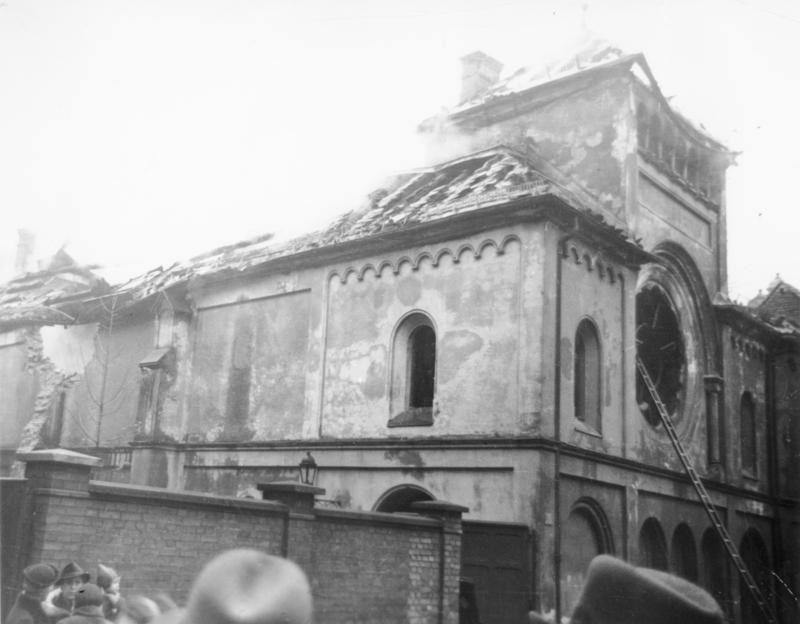
The Ohel Jakob synagogue in Munich, burned on Kristallnacht, 9 to 10 November 1938. The race libel did not stay on paper.Bundesarchiv, Bild 146-1970-041-46 / CC-BY-SA 3.0
The Talmud, Forged
The "shocking quotes" that circulate online are forged, mistranslated, or stripped of context, many traced to the same 19th and 20th-century frauds, and one popularised by the Nazi Party's chief ideologue. Here is what the texts actually say.
“Blood in the matzo”
The blood libel’s supposed “scripture.” No such command exists. The Torah forbids consuming blood at all (Leviticus 17). The accusation has no source because it has no truth.
Sanhedrin 55b, “the three-year-old”
Passed around as proof the Talmud permits child rape. The passage does the opposite: it is a dry discussion of legal liability, defining the age at which the crime of rape is reckoned in court. The Talmud and Jewish law forbid the act. The modern slur was popularised by Alfred Rosenberg, the Nazi Party’s chief ideologue, in Unmoral im Talmud (1920).
“Kill the best of the gentiles”
Not in the Talmud. A line from a 19th-century forgery, traced to frauds like Justinas Pranaitis, presented as a quotation it never was.
Metzitzah, recast as “pedophilia”
A step in the circumcision ritual that draws blood from the wound, smeared as sexual abuse. It is not. There is a real, separate public-health debate about one form of it and herpes transmission. That is a medical argument. Antisemites turn it into an accusation of a crime.
Kol Nidre, “Jewish oaths are worthless”
The Yom Kippur prayer annuls rash vows made to God, ritual promises, not contracts, testimony or obligations to other people. A prayer of conscience, turned into proof of Jewish dishonesty.
The Golden-Age Myth, Complicated
One reply to all this is that Jews were always safe under Islam, the “protected People of the Book.” The record is more mixed than either side wants it to be, and the mixed version holds up better than either myth.
There is some truth to it. For long stretches Jews fared better under Islam than under Christendom: the blood libel was a Christian invention, and Muslim Spain produced a genuine golden age of Jewish poetry, philosophy and medicine, of men like Maimonides.
But “well-treated” overstates it. Jews lived as dhimmis, protected but legally subordinate, paying the jizya tax “while humbled” (Quran 9:29) and barred at times from building synagogues, riding horses or testifying against a Muslim. And the tolerance was fragile. It broke into massacre often enough: Granada in 1066, where a Muslim mob murdered thousands of Jews in a single day; the Almohad persecutions that drove Maimonides himself into exile; Fez, Tetouan, Mashhad; and into the modern age, the Farhud, a two-day pogrom that Grand MuftiAmin al-Husseini helped incite in Baghdad in June 1941, killing roughly 180 Jews, months before he fled to Berlin to broadcast Nazi propaganda for Hitler.
The record lands neither on the unbroken paradise its defenders claim nor the unbroken hell its critics describe: subordination punctuated by massacre, and at its best, real coexistence. It was simply never the equality the myth implies, and it does not cancel the hatred this page traces. The forgotten refugees →
From the Pulpit
The libels are not only history. They are preached now, by name, from real pulpits and on state television, sometimes by men the West calls moderate. The same faith also produces the opposite: imams who fight the hatred head-on, at real personal cost. The two columns are deliberately uneven, because the reality is. What follows is a sample, not a census.
Source key.MEMRI (Middle East Media Research Institute) and PMW (Palestinian Media Watch) translate and archive the original Arabic sermons and broadcasts, with the source video. ADL = Anti-Defamation League · AJC = American Jewish Committee · AIJAC = Australia/Israel & Jewish Affairs Council. These are monitoring and translation bodies; the words quoted are the speakers' own, on camera, on state TV, or in court.
Incitement, on the record
These are not fringe nobodies. They include the Imam of the Grand Mosque in Mecca, sitting Grand Muftis (a country or city's top Islamic legal authority, whose rulings carry real religious weight), an ayatollah who is a head of state, elected legislators and mosque preachers in Western capitals, saying this in the open, on camera or live on state TV. For every name here, there are many more.
Not only the Jews
The same supremacism turns on everyone outside the faith: Christians, Hindus, apostates, “the kuffar.” The Jew is the first target, not the only one. That shows what this is: an ideology of domination, not a grievance about one strip of land.
And the imams who refuse it
Fewer, and braver. Several paid with their careers, their safety, or exile for saying it out loud. Each is a person who chose conscience over the crowd, and proof that the enemy is an ideology, not a people.
More of them, and the nations standing with Israel, on Allies & Friends.
How to read this. A hatred this old learns to disguise itself, and the test is not the topic, it is the pattern: demonisation, double standards, delegitimisation, singling out the one Jewish state for a measure no other nation faces, then dressing the singling-out in the language of justice. That is not the same as saying every criticism of Israel is antisemitism, it isn't, Israel can be judged like any state, but the disguise is real and this is how you see through it. The words change every century. The pattern is what gives it away.
Sources. The blood libel and William of Norwich (1144); the 1348–49 well-poisoning massacres (Strasbourg); the English coin-clipping arrests (1278) and expulsion (1290); The Protocols of the Elders of Zion as a forgery exposed by The Times (1921), cited in the 1988 Hamas Covenant (Art. 32); UN Resolution 3379 (1975) and its revocation, 46/86 (1991); the Second Vatican Council, Nostra Aetate (1965); the Sanhedrin 55b passage via the open Sefaria library and the IHRA working definition of antisemitism. Distortions of Jewish texts are documented at length by scholars and debunking projects.