Three defences get made of this phrase, and the documents answer all three. The first: it is only about equal rights. The map answers that. The second: it protests the occupation that began in 1967. But the phrase's own charter is from 1964, three years before the occupation existed. The third: its meaning is set by whoever is chanting it. But the phrase has authors, and the authors published what they mean.
Hamas's 2017 document, the text circulated abroad as evidence of moderation, states that Hamas “rejects any alternative to the full and complete liberation of Palestine, from the river to the sea.” Its offer of a state on the 1967 lines comes in the same article, after that sentence rather than instead of it.
The PLO's founding charter, 28 May 1964, claims Palestine “with its boundaries at the time of the British Mandate” as an indivisible unit, while Article 24 disclaims the West Bank and Gaza, then held by Jordan and Egypt. Three years before Israel held either.
People living in Israel on 19 April 2026: 7.79 million in the category Israel's Central Bureau of Statistics labels Jews and others, 2.157 million Arabs, and 296,000 foreigners. That is the ground the map covers.
What the words actually describe
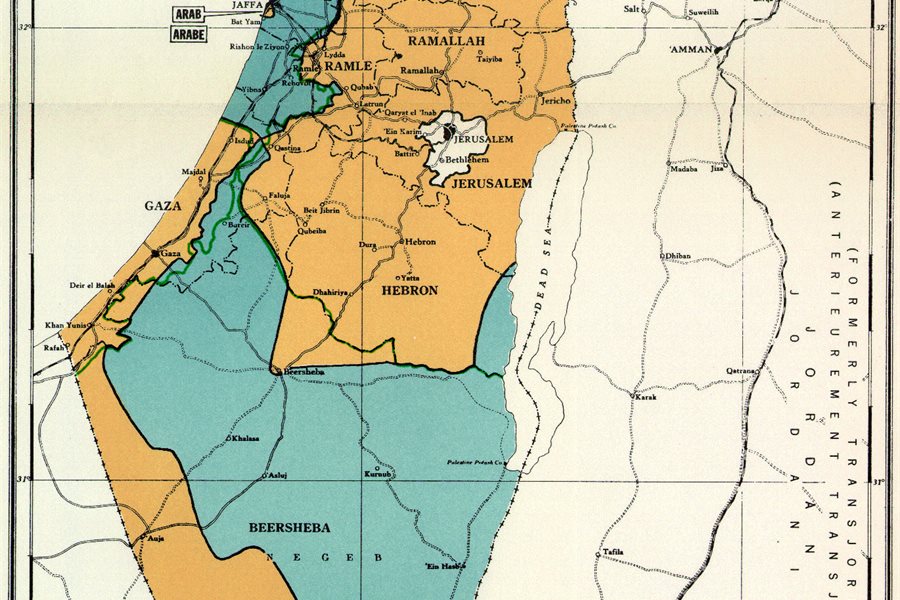
The Jordan River runs down the eastern edge of the territory. The Mediterranean is the western coast. Between the two sit three things, not one: Israel inside its 1949 armistice lines, the West Bank, and the Gaza Strip. Anyone who tells you the space between the river and the sea simply is Israel has handed you an error, and the correction does not help the slogan. It makes the real problem clearer, not smaller.
Because a Palestine that is free across all three is a Palestine in place of Israel, not beside it. There is no version of that map on which a Jewish state still exists. If you want to call for a Palestinian state in the West Bank and Gaza, ordinary words for that exist. This phrase is not those words, and it was not chosen by accident.
Both readings, in their own words
The slogan has a defence. Here it is, next to the documents written by the organizations that carry the phrase. Read them in the same sitting.
Maha Nassar, a Palestinian historian at the University of Arizona, made the case in The Conversation on 16 November 2023. She writes that most Palestinians who use the phrase do so because they believe that:
in 10 short words, it sums up their personal ties, their national rights and their vision for the land they call Palestine.
On the charge that “free” means free of Jews, she makes a point about the Arabic that is simply correct:
the Arabic original, “Filastin hurra,” means liberated Palestine. “Free from” would be a different Arabic word altogether.
Congresswoman Rashida Tlaib defended the phrase in the same weeks as “an aspirational call for freedom, human rights, and peaceful coexistence.” The House censured her over it on 7 November 2023, 234 to 188, with 22 Democrats voting yes.
Maha Nassar, The Conversation, 16 November 2023 · H.Res. 845, full text
Hamas, 2017, Article 2 defines the territory and Article 20 states the demand:
Palestine, which extends from the River Jordan in the east to the Mediterranean in the west …
Hamas rejects any alternative to the full and complete liberation of Palestine, from the river to the sea.
Hamas, 1988, the covenant that document never annulled. Khaled Mashal said as much himself, presenting the 2017 text at a press conference in Doha on 1 May 2017:
The old charter was a product of its era, 30 years ago. We live in a different world today.
A description, not a repeal. The 1988 covenant itself says:
Israel will exist and will continue to exist until Islam will obliterate it, just as it obliterated others before it.
The land of Palestine is an Islamic Waqf consecrated for future Moslem generations until Judgement Day. It, or any part of it, should not be given up.
2017 document, full text · 1988 covenant, Avalon Project, Yale · Mashal's remarks, Doha, 1 May 2017 · Both charters, side by side
Nassar is right about the Arabic and it settles nothing, because the objection was never that hurra secretly means cleansed. The objection is about what "free" is describing. A liberated Palestine across the whole territory still requires that the state currently governing most of it stop existing, and the movements that put the phrase in writing have never left that to guesswork: they wrote the geography into Article 2 and the demand into Article 20, in the same document that was sold to Western readers as the moderate one.
So the defence answers a question about vocabulary. The slogan asks a question about sovereignty.
The date, honestly
Nobody holds a recording of the first time the sentence was spoken, and any page that gives you a founding date for the chant is guessing. What has a date on it is the map.
The Palestine National Charter of 28 May 1964 is the document. Article 2 reads: “Palestine, with its boundaries at the time of the British Mandate, is a indivisible territorial unit.” Mandate boundaries means the river to the sea. And then the part that gives the whole thing away, Article 24, verbatim: “This Organization does not exercise any territorial sovereignty over the West Bank in the Hashemite Kingdom of Jordan, on the Gaza Strip or in the Himmah Area.”
Read those two together. In 1964 the West Bank was Jordanian and Gaza was Egyptian, and the PLO explicitly disclaimed both. So a charter that claims the whole of Mandate Palestine as indivisible while renouncing the two territories Israel did not hold is claiming exactly one thing: Israel, inside its 1949 lines. After the 1967 war put those territories in Israeli hands, the 1968 revision quietly deleted Article 24 and the map went back to being indivisible.
This matters because the most common defence of the chant is that it protests the occupation. The map predates the occupation by three years. Nassar herself dates the phrase's traction to after 1967, when the demand became that all the land be returned; both accounts land on the same territory, and only one of them comes with a document and a year on it.
The question a reader actually has
Not what the word “free” means. What happens to the ten million people already living there.
Israel's Central Bureau of Statistics counted 10.244 million people in Israel on 19 April 2026: 7.79 million in the category it labels Jews and others, 2.157 million Arabs, and 296,000 foreigners. The one-state map the slogan describes is drawn over all of them. Someone has to say what becomes of them, and the movement that owns the phrase has answered in writing more than once.
The 2017 document offers the reassuring version, Article 16: “Hamas affirms that its conflict is with the Zionist project not with the Jews because of their religion.” Set it beside Article 7 of the covenant it never repealed, which quotes a hadith on what the end looks like: “The Day of Judgement will not come about until Moslems fight the Jews, when the Jew will hide behind stones and trees. The trees will say: O Moslem, there is a Jew behind me, come and kill him.” And Article 13: “There is no solution for the Palestinian question except through Jihad. Initiatives, proposals and international conferences are a waste of time.”
On 7 October 2023, Hamas acted out the 1988 text, not the 2017 press release. The question of which document really governs Hamas was answered that morning, by what Hamas did rather than by what its spokesmen printed. A reader is entitled to weigh the friendly clause against the unrepealed one; they are not entitled to be shown only the friendly clause, which is how the phrase is usually introduced.
What the crowd chanting it knows
In December 2023, the Berkeley political scientist Ron Hassner had 250 US students surveyed. Support was overwhelming: 32.8 percent backed the slogan enthusiastically and another 53.2 percent to a lesser degree. Then came the map test. Only 47 percent of the students who embraced the slogan could name the river and the sea. Guesses included the Nile, the Euphrates and the Caribbean.
Told basic facts about the region, 67.8 percent of supporters dropped it. Among the 80 who were simply shown a map, 75 percent changed their view. A belief that collapses the moment its holder sees a map was never a considered position about equality. It was a slogan people repeated without knowing what it describes.
Most of the crowd is not eliminationist; a large part of it is uninformed, and uninformed people can be told the truth. But sincerity is a fact about the chanter, not about the chant. The words were written by organizations that published what they meant by them, and a marcher who has not read the charter is still carrying its sentence through the street.
You will hear the counter within a day of reading this, and it will sound reasonable: that Israeli politicians use the same river-to-sea geography, so the phrase cannot be eliminationist on its own. The geography is genuinely not exclusive to one side, and the strongest document for that case is the Likud party's original 1977 platform, under the heading “The Right of the Jewish People to the Land of Israel”:
Judea and Samaria will not be handed to any foreign administration; between the Sea and the Jordan there will only be Israeli sovereignty.
That is a real claim to the whole territory, from the party that has led most Israeli governments since. But it is a party platform, not a founding text, and the same party signed the Hebron Protocol in 1997 and the Wye River Memorandum in 1998, both of which handed security and civil control over parts of that territory to the Palestinian Authority. And the sentence itself claims sovereignty. It does not ask for the removal of the people living under it, which is what the documents on the other side ask for.
The wider record breaks the same way. The Zionist leadership accepted partition in principle at the 20th Zionist Congress in August 1937: the Congress called the Peel borders unacceptable but authorized negotiations toward a Jewish state. The state accepted UN General Assembly Resolution 181 in 1947, and made territorial offers at Camp David in 2000 and again under Olmert in 2008. The slogan's authors rejected partition every time and wrote down what they wanted instead.
So the answer to the question at the top is short. One state, over all of it. Every organization that wrote the phrase down has said which state that is, and none of them has ever said Israel.
Sources
- Hamas, A Document of General Principles and Policies, 2017, full text (Jewish Virtual Library). Articles 2, 16 and 20.
- The Hamas Covenant, 1988, full text (Avalon Project, Yale Law School). Preamble, Articles 7, 11 and 13.
- Palestine National Charter, 28 May 1964, full text including Article 24 (ETH Zurich archive).
- The Palestinian National Charter as amended in 1968, Article 24 removed (Avalon Project, Yale Law School).
- Population of Israel (Israel Central Bureau of Statistics, media release 117/2026, 19 April 2026).
- Resolution of the 20th Zionist Congress on the Peel Commission partition scheme, Zurich, August 1937 (primary text transcription).
- UN General Assembly Resolution 181 (II), 29 November 1947, full text (Avalon Project, Yale Law School).
- Original Party Platform of the Likud Party, 1977, full text (Jewish Virtual Library).
- Protocol on Redeployment in Hebron, 15 January 1997 (Avalon Project, Yale).
- The Wye River Memorandum, 23 October 1998 (Avalon Project, Yale).
- Khaled Mashal's remarks at the Doha press conference presenting Hamas's 2017 document (Al Jazeera, 2 May 2017, reporting the 1 May 2017 press conference).
- Maha Nassar, From the river to the sea: a Palestinian historian explores the meaning and intent of a scrutinized slogan (The Conversation, 16 November 2023).
- Ron Hassner, From Which River to Which Sea? (Helen Diller Institute, UC Berkeley, 5 December 2023).
- H.Res. 845, Censuring Representative Rashida Tlaib, full text (US Government Publishing Office).
The two founding documents, side by sideWhat they are actually chantingThe conflict, claim by claimThe hardest case against Israel, answeredThe words are the battlefieldThe full fact-check