Neither claim is an inheritance. Both are 20th-century borrowings. The Canaanites were the Bronze Age people of the land, and their language survives in exactly one living descendant: Hebrew. The Philistines were invaders from the Aegean who fought the Canaanites and the Israelites alike, and who vanished from history in 604 BCE. Arabic and Arab identity reached the land with the Muslim conquest of the 630s CE. And when Palestinian Arab leaders first described themselves to the world, in 1919, they did not say Canaan. They said Syria.
The only Canaanite language still spoken on earth. Phoenician, Moabite, Ammonite and Edomite are all dead. The Book of Isaiah, 19:18, calls Hebrew “the language of Canaan.” Arabic belongs to a different branch of the Semitic family and arrived in the 7th century CE.
Babylon's King Nebuchadnezzar takes the Philistine city of Ashkelon and “turned the city into a mound and heaps of ruins.” The Philistines disappear from the record after Babylon's campaign: about 1,240 years before the Arab conquest.
The First Palestine Arab Congress in Jerusalem, cabling the Paris Peace Conference: “We consider Palestine nothing but part of Arab Syria and it has never been separated from it at any stage.” No Canaan. No Philistia.
Who is saying it
This is not a fringe meme that wandered onto your feed. It is the official line of the Palestinian Authority, said by its leaders on camera.
Mahmoud Abbas, president of the Palestinian Authority, at the Jalazone refugee camp north of Ramallah on 10 August 2019, said the land belongs to “the Canaanites who were here 5,000 years ago,” and then, plainly:
We are the Canaanites.
On official PA television in 2016 he went further, claiming that the “Canaanite-Palestinians” invented the alphabet. Saeb Erekat, the PLO's chief negotiator, said it to an Israeli minister's face at a security conference in Munich in February 2014:
I am the proud son of the Canaanites who were there 5,500 years before Joshua bin Nun burned down the town of Jericho.
Erekat's own family tree, posted on Facebook, traced his clan to the Huwaitat tribe of Arabia, which moved up from the Hejaz through Aqaba. The man claiming 5,500 years in Jericho was quoting a family history that said otherwise. Today the line is everywhere: protest signs, viral threads and AI chatbot answers, usually alongside its contradiction, the Philistines.
The Canaanites: whose language survived?
Canaan was a land of Bronze Age city-states, not an ethnic nation in the modern sense. The earliest stone that names it names Israel beside it.
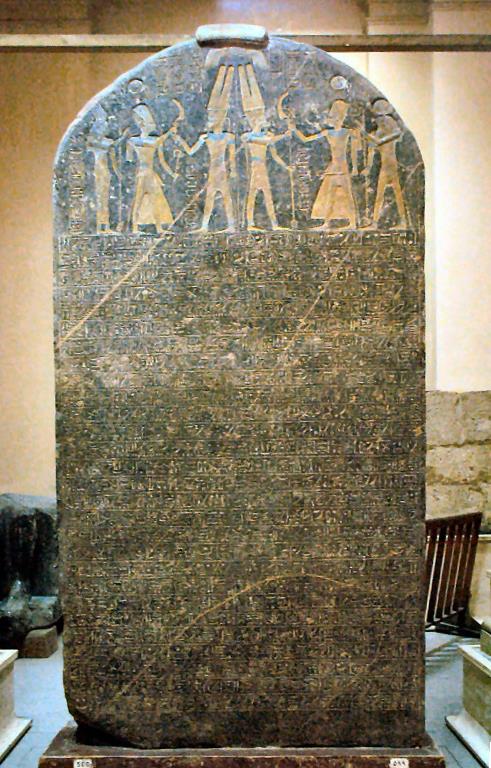
The languages of Canaan were a family: Hebrew, Phoenician, Moabite, Ammonite, Edomite. Israel grew up inside that world, which is why biblical Hebrew is a Canaanite language and why Isaiah could call it the language of Canaan. Then the family died off branch by branch. Aramaic replaced the local tongues as the region's working language under the Persian empire from the 6th century BCE, Greek joined it after Alexander, and Arabic arrived with the armies of the caliphate between 634 and 640 CE.
One branch never died. Hebrew was prayed, studied and written without a break for the next two thousand years, and revived as a spoken language in the land in the late 19th century. For well over a thousand years before the 20th century, no community anywhere called itself Canaanite, worshipped Canaan's gods or spoke a Canaanite language, except the Jews, who never stopped speaking one.
The heirs of Canaan's language are not hard to find. They are reading this page in it.
The DNA card, and why it loses
The strongest version of the claim cites real science. Read what the science found.
In 2017, Marc Haber and colleagues sequenced 3,700-year-old Canaanite skeletons from Sidon in Lebanon and found that modern Lebanese carry most of their ancestry from that Bronze Age population. In 2020, Lily Agranat-Tamir, David Reich, Israel Finkelstein and colleagues published 73 ancient genomes from the southern Levant in Cell. The press releases from Tel Aviv University and the Hebrew University summarized the result: modern Jewish groups and modern Arabic-speaking groups in the region both carry a large share of their ancestry from that Bronze Age gene pool.
So the genetics do not hand Palestinians an exclusive title. They make Jews Canaanite-descended too. A piece of evidence that proves the other side's claim exactly as well as yours is not an argument for yours. And DNA is not identity: genes carry no language, no memory, no gods, no name. The Lebanese made the same move in the 20th century, reaching back to the Phoenicians, without anyone pretending it gave Beirut a deed to the Galilee.
Palestinian families' own traditions point the other way. Most trace their founders to Arab tribes from the Hejaz, Yemen, Egypt and Iraq, which is why surnames like al-Masri (“the Egyptian”) are common in Gaza and the West Bank. Hamas's interior minister Fathi Hammad said it on Egyptian television on 23 March 2012, while pleading with Egypt for fuel:
Half of the Palestinians are Egyptians and the other half are Saudis.
A senior official of the government ruling Gaza, contradicting the Canaanite line in public, because on that day a different ancestry was more useful.
The Philistines: the invaders
The second claim is worse than the first, because the people it names were the land's best-documented colonists.
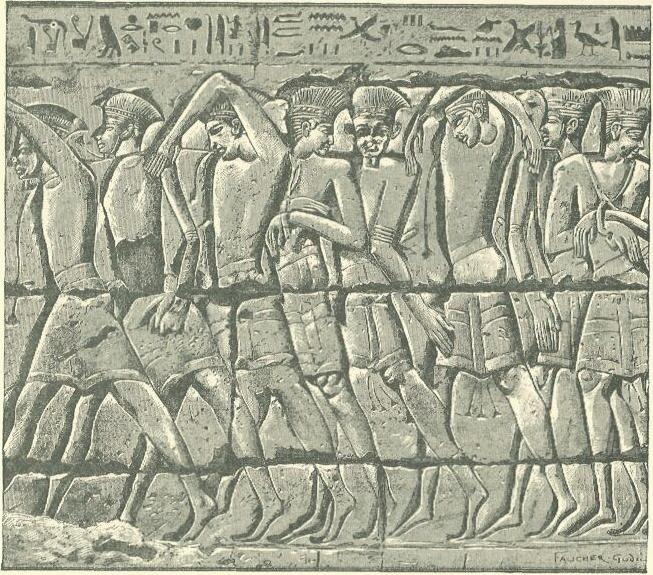
The Philistines were one of the Sea Peoples, raiders and migrants who swept across the eastern Mediterranean at the end of the Bronze Age. Egypt's Ramesses III recorded fighting them, and they settled the southern coast of Canaan around the early 12th century BCE in five cities: Gaza, Ashkelon, Ashdod, Ekron and Gath. Their pottery copies Aegean styles, their early burials are Aegean in custom, and at least one of their 7th-century kings, named on the royal inscription found at Ekron in 1996, carried a non-Semitic name, Ikausu (biblical Achish), which scholars connect to “Achaean,” meaning Greek.
In 2019, a team led by Michal Feldman and Daniel Master published DNA from the cemetery at Ashkelon in Science Advances. The infants buried under 12th-century Philistine houses carried a European-related ancestry component the earlier Canaanite residents of the city did not have, with southern Europe the most plausible source. Within about two centuries it was diluted into the local population. Then, at the end of 604 BCE, Babylon captured Ashkelon's king, plundered the city and razed it, and its people were deported to Babylon. After that, the Philistines are gone from history. No Philistine people, language or name survives into the Persian, Greek, Roman or Byzantine centuries, let alone into the Arab one.
Follow the claim to its end. If Palestinians were Philistines, they would descend from sea-borne settlers who arrived from the Aegean and took the coast by force, the exact story the same movement tells about the Jews. The Philistine claim is the colonizer story, told about themselves.
So where did the name come from?
This is the one true thing inside the Philistine claim, and it proves the opposite of what it is used for.
5th century BCE: the Greek historian Herodotus writes of the “Syrians of Palestine,” using Palaistinē, from the Philistine coast, for the region. A geographic word, used by an outsider.
c. 135 CE: after crushing the Bar Kokhba revolt, the last Jewish war for independence in antiquity, Rome renames the province of Judaea as Syria Palaestina, replacing the Jewish name with that of the Jews' ancient enemies.
7th century CE: the Arab conquerors take over the Roman administrative name as Filastin, a military district of the caliphate. Arabic borrowed the label of a province. It did not inherit a people.
Under the British Mandate (1920 to 1948), “Palestinian” was used above all by Jewish institutions. The Jerusalem Post was founded in 1932 as The Palestine Post. The Israel Philharmonic was founded in 1936 as the Palestine Orchestra. In 1942 the British Army formed the Palestine Regiment, most of its volunteers Jewish.
Arab leaders, meanwhile, rejected the label. The 1919 Congress called the land part of Arab Syria, and in 1919 and 1920 the leading Arab nationalist newspaper in Jerusalem was named Suriya al-Janubiyya, “Southern Syria.” A distinct Palestinian Arab national identity crystallized after the Mandate drew the borders.
A name Rome stamped on Judea to erase the Jews from the map is not a family tree. Palestine was a province before it was a people, and for most of the 20th century the people who called themselves Palestinians were the Jews.
What you will hear next
Three replies come after this one, and each sounds convincing for about a minute.
“DNA proves Palestinians are the original people.” It proves that Jews and Arabic-speaking Levantines share deep local ancestry, which is why it cannot be used as a title for one of them. The 2020 Cell study put Jewish groups in the same result.
“Today's Jews are Europeans, Khazar converts, not Middle Eastern.” This is the follow-up that tries to remove the Jews from that DNA result. The genetics say the opposite: Ashkenazi, Sephardi and Mizrahi Jews share a Middle Eastern core across their communities. The Khazar claim, checked.
“A nation doesn't need ancient roots to be real.” True, and it is the end of the argument. If Palestinian identity stands on its 20th-century foundations, the Canaanite pedigree is unnecessary, and the only remaining reason to claim it is to deny the Jews a 3,000-year tie that is written down, dug up and still spoken. Ancient ancestry cannot be decisive when Palestinians claim it and absurd when Jews do. The double standard on ancient claims.
So the answer is short. Canaan's language is still spoken. It's Hebrew.
Sources
- Isaiah 19:18, “the language of Canaan” (Sefaria, Hebrew and English).
- Babylonian Chronicle ABC 5 (the Jerusalem Chronicle), obverse lines 15 to 20, Nebuchadnezzar's capture and destruction of Ashkelon, end of 604 BCE (Livius).
- The Palestine Arab Congress, resolutions of the First Congress, Jerusalem, 1919 (Jewish Virtual Library).
- Abbas: Settlements will be swept away, Palestinians came from ancient Canaanites (Times of Israel, 13 August 2019, on the Jalazone speech of 10 August 2019).
- Palestinian Media Watch on Abbas's PA TV claims of 5,000 to 6,000 years and the “Canaanite-Palestinian” alphabet (Israel National News).
- PA negotiator Saeb Erekat claims family was Canaanite, and his family tree (Algemeiner, 2 February 2014).
- Hamas official to Egypt: “Half the Palestinians are Egyptians” (Washington Free Beacon, 4 April 2012, citing MEMRI's translation of Fathi Hammad's 23 March 2012 broadcast).
- The origins of the Palestinians, as told in their own family traditions (Mosaic, August 2017, on Pinhas Inbari's study for the Jerusalem Center for Public Affairs).
- Haber et al., Continuity and admixture in the last five millennia of Levantine history from ancient Canaanite and present-day Lebanese genome sequences (American Journal of Human Genetics, 2017).
- Agranat-Tamir et al., The Genomic History of the Bronze Age Southern Levant (Cell, 2020), and Tel Aviv University's summary of its findings on modern populations.
- Feldman et al., Ancient DNA sheds light on the genetic origins of early Iron Age Philistines (Science Advances, 2019), and the Max Planck Institute's release.
- Ekron, including the royal dedicatory inscription naming Ikausu (Achish) (Jewish Virtual Library).
- Herodotus, Histories 7.89, the “Syrians of Palestine” (Perseus Digital Library, Tufts).
- The origin of the name “Palestine”, from Philistia to Syria Palaestina (Jewish Virtual Library).
- Procession of Philistine captives at Medinet Habu (Wikimedia Commons, public domain).
“Promised 3,000 years ago”The cities, name by nameRace, religion or a people?The languages of the landThe double standardThe full fact-check